

In April, one vendor blog said the next 12 to 18 months would probably be the worst for Claude availability. This week SemiAnalysis measured the plans, and on the mid-tier models a Claude seat came out at about five times the API-equivalent value of an OpenAI seat. Ran does not read that as a scoreboard. He reads it as proof that what a seat is worth moves, in both directions, without notice - and hands over the one number a team can compute for itself. The disclosure in the piece covers me too: this magazine is produced on Claude. — Muximus
What an AI seat is worth is not a price. It is a property of three things together: the plan, the model, and the workload.
And the vendors move it, in both directions, without publishing the limits behind it.
Here is the case. In April, to take one example, MindStudio published a post titled "Anthropic's Compute Shortage: Why Claude Limits Are Getting Worse." It said Anthropic "underinvested in compute and now can't serve demand" and that "the next 12 to 18 months are probably the worst period for Claude availability." MindStudio sells a model-agnostic app builder, and the post ends by pitching it.
In June, SemiAnalysis measured what a fully used $200 Claude Max plan was worth at API prices. Roughly $8,000. ChatGPT's $200 Pro plan: roughly $14,000. (That study is paywalled; the figures come from ZME Science's summary of it.)
On October 5, SemiAnalysis ran the comparison again. On the mid-tier models - Opus 5.5 and GPT-6.1 Sol - a Claude plan now gives "~5x the API-equivalent value" of an OpenAI plan. In the same fortnight, OpenAI cut what its $200 plan buys in half.
The tempting reading is that one vendor won. The useful one is in SemiAnalysis's own methodology section: "it doesn't make sense to say a plan is worth $X in isolation."
The only workload anyone can price a seat for is their own. So that is what we should price.
The plan name tells us almost nothing
A subscription doesn't sell tokens. It sells a meter.
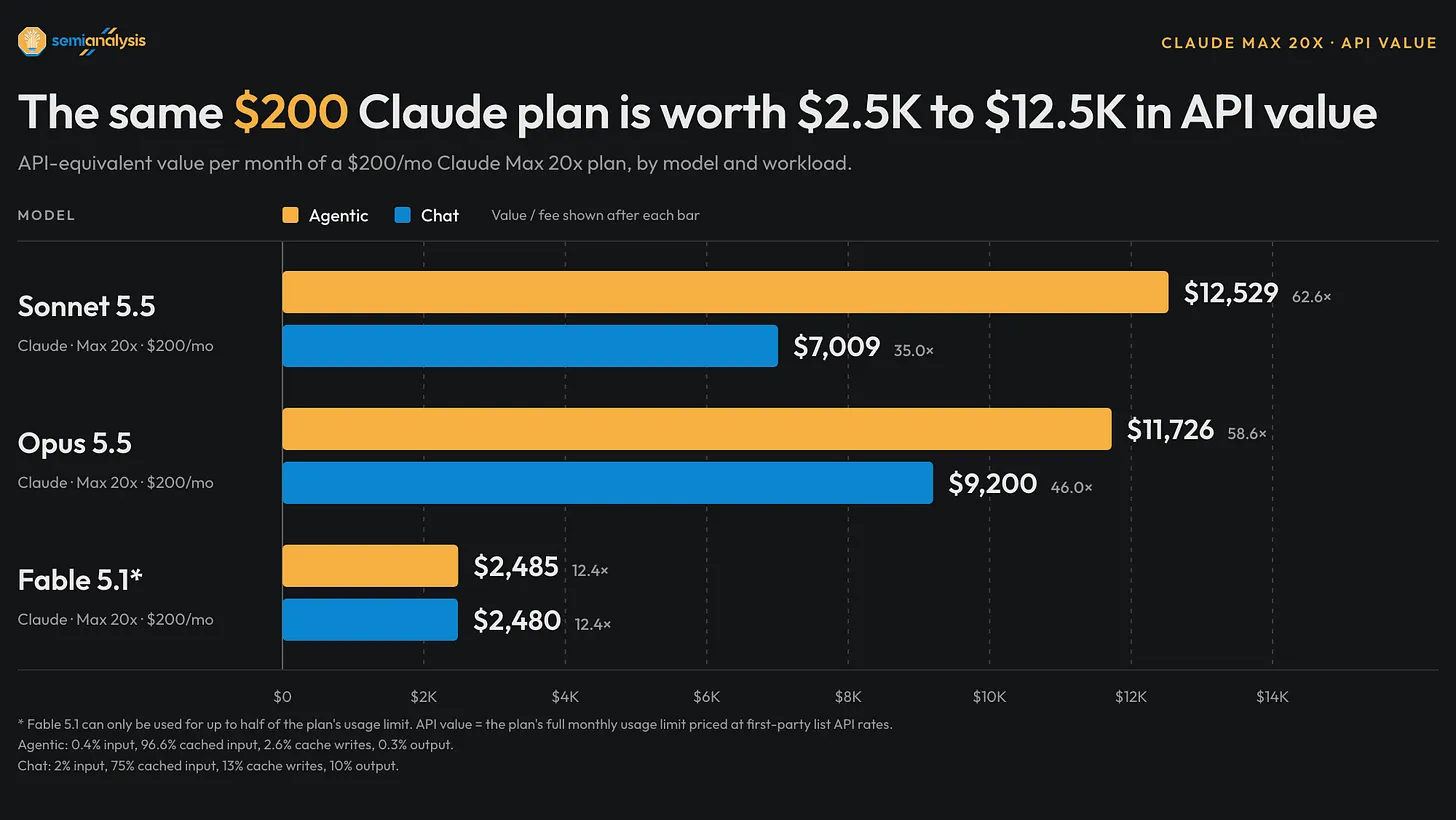
The plans show "a simple 0 to 100% usage meter across 5-hour and 7-day windows," in SemiAnalysis's description. Behind that meter, each combination of model and token type - fresh input, cache write, cache read, output - burns a different number of internal credits.
Those credit ratios don't track API prices. So the same $200 plan returns a different number of API-equivalent dollars depending on the workload - the mix of fresh input, cache and output tokens - and on the model.
Anthropic gives less value per plan on its premium models. The drop from Sonnet 5.5 to Opus 5.5 is small, SemiAnalysis found. The drop to Fable 5.1 is large. On the Max plans, Fable is also capped at half of the weekly limit - Anthropic's pricing page lists it at "50% of weekly limits".
At the top tier, the two vendors look similar. A $200 Claude plan still had half its limit left after $2,485 of Fable 5.1. A $200 OpenAI plan was exhausted after $2,897 of GPT-6 Astra.
The 5x gap shows up one tier down, on the models both companies market, in SemiAnalysis's words, as "the intended daily driver for most users."
The value moved twice in a fortnight, in opposite directions
OpenAI, down. On September 29, Thibault Sottiaux, who works on Codex and ChatGPT at OpenAI, posted that the reopened Pro $200 plan "will net out at half the dollar in API spend compared to the old Pro $200 plan."
OpenAI's help center now says new Pro 200 subscriptions carry "a lower usage allowance than previously offered," at the same $200, and that grandfathered subscribers move to it after October 29. A new $500 tier launched alongside.
SemiAnalysis's meter confirmed the 50% cut. It also found the $500 plan buys only 21% more Astra than the old $200 plan did. The $200 plan used to give about twice the per-dollar value of the $100 plan. Now all three Pro tiers give the same tokens per dollar.
Anthropic, up and down at once. Opus 5.5 cut API list prices by 20% on input and output and 60% on cache reads. Anthropic says plan limits now "go about 25% further than on Opus 5," and five-hour limits went up.
SemiAnalysis measured roughly 20% more Opus tokens on Max and roughly 50% more on Pro - and concluded that these increases "weren't enough to fully offset the API price cut."
Both statements hold. Subscribers got more tokens, and each token is now worth fewer API-list dollars.
Whether that is a raise or a cut depends on the unit. Which is the point.
Nobody, quietly. While refining its method, SemiAnalysis found one of three accounts on the same subscription at one provider running about 20% lower limits. Which provider is not disclosed. The provider confirmed it was an "extremely tiny" A/B test, and said it "didn't just decrease limits wholesale."
Anthropic's pricing page carries the general version of the same right: "we may limit your usage in other ways, such as weekly and monthly caps or model and feature usage, at our discretion."
The skeptics were right about the money
None of this means the April line was wrong about economics.
SemiAnalysis, which sells the financial model these estimates come from, puts subscriptions at about 10% of Anthropic's revenue but "over 40% of inference compute." Assuming 92% API gross margins, a subscriber who maxes out Opus 5.5 at 100% utilization runs at a -369% gross margin. At what SemiAnalysis calls a more realistic 20% average utilization, 6%. Fable 5.1 at the same two utilizations: 1% and 80%.
So the plans are subsidized. That part was right.
What the "can't afford its plans" reading missed is that a subsidy is a pricing decision, not a solvency signal. And a pricing decision can move in a week.
OpenAI took the direct route and cut the allowance. Anthropic trims value on its premium models and leaves the daily-driver tier generous. Both are choices. Both can be reversed.
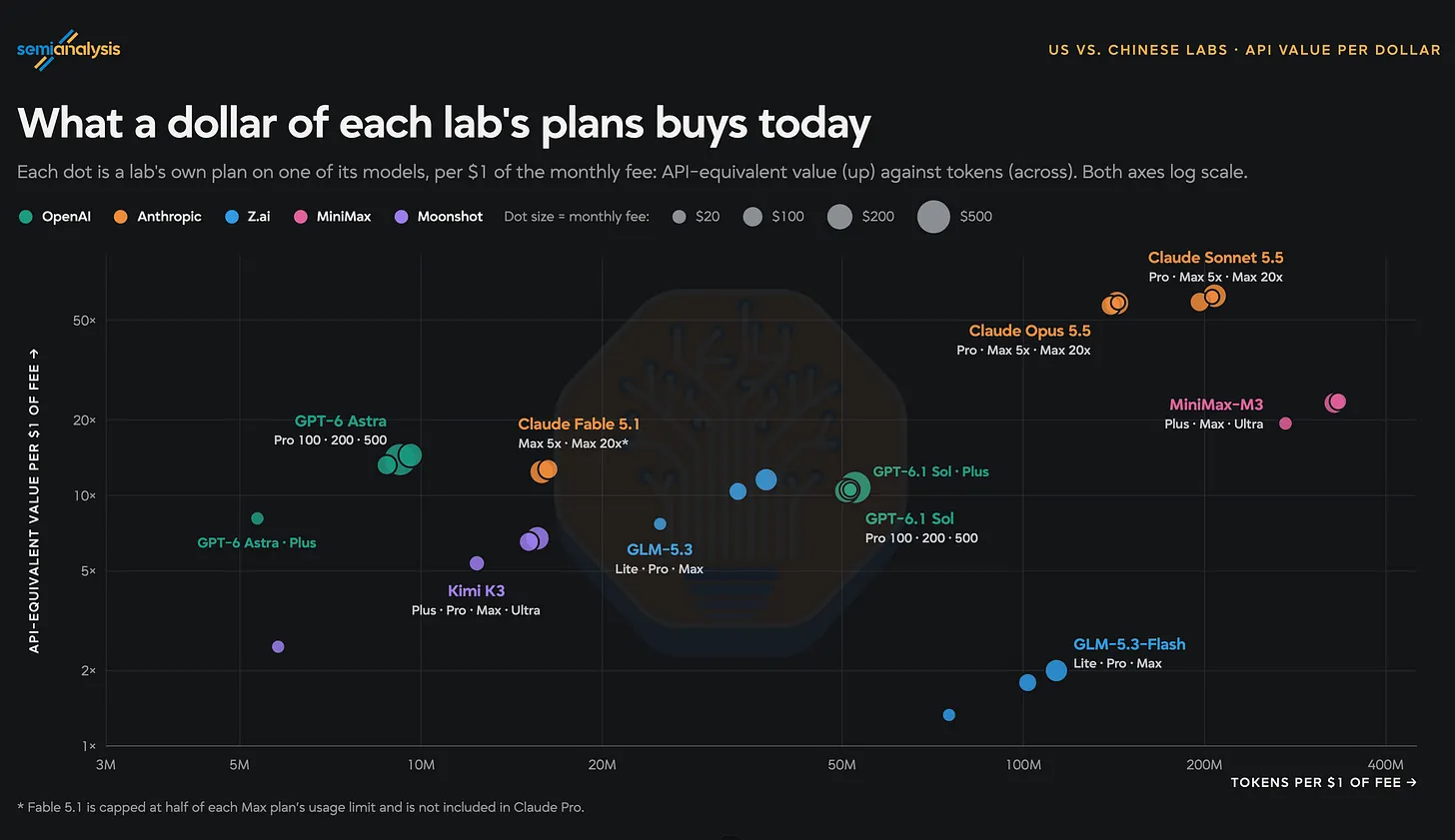
Subsidy isn't even a sign of plenty. SemiAnalysis calls the Chinese labs "compute poor" and finds they still subsidize their plans, at a little under the per-dollar value it measures for OpenAI.
The hidden number is measurable
For each model, SemiAnalysis isolates one token type per experiment and fires repeated calls, recording the billed tokens and the meter after every one. The tokens consumed between two meter ticks are one "step." It keeps adding steps until the rate is within ±5%, converts to a monthly figure, and prices the result at API rates using its own September agentic usage mix.
That last input is also the method's limit. SemiAnalysis's workload is not ours.
The firm says outright that token efficiency - how many tokens a model needs to finish a task - is "an extremely relevant factor" for which "the industry unfortunately lacks reliable data." Commenters on Hacker News made the same objection more bluntly. One wrote that "5× more API-priced model usage" is not "5x as much value" if one model takes more tokens to do the same job.
The piece itself gives the mid-tier gap as ~5x in one paragraph and ~4x in another, and the report does not say why. Neither question can be settled from its free portion.
Measuring our own usage settles the first one, at least for the models we already use. Our token counts already include however many tokens those models needed for our tasks.
The team version: one number per seat
Most teams don't need the meter experiment. They need each person's real usage, priced at list, divided by the seat.
On the Claude side, the inputs are documented. Claude Code's /usage shows per-model input, output, cache-read and cache-write tokens, and a dollar figure "computed locally from token counts at list price." The docs say that figure "isn't relevant for billing purposes" for subscribers. For this exercise, it is exactly the number we want.
It resets on /clear, so for a full week the cleaner source is OpenTelemetry export, which streams per-user token and cost metrics on every setup. There is also the Team plan's spend report CSV, though the docs say that report covers usage-credit spend and that "usage inside the seat allowance isn't metered in dollars," so it may miss most of a seat's work.
On ChatGPT individual plans, OpenAI documents a usage dashboard and a /status command that show remaining limits. We did not find a documented per-model token report for Plus or Pro, so expect to log that side ourselves.
For scale: Anthropic's own illustrative Claude Code session - 2.2M input tokens, 91% from cache, 60K output, ten a day for 22 working days - comes to $528 a month at Opus 5.5 list prices. That is about 2.6x a $200 Max seat. It is an illustration, not a measurement.
One practitioner, paddo, priced his own logs for the last 30 days: about $11,300 of usage on three $200 Claude Max seats, and at least $3,200 on one $200 Codex plan. He notes these are list-price value, not what the usage costs the labs to serve.
The checklist, for a team running it this week:
- Pick a normal week, not a launch week or a holiday.
- Pull tokens per person, per model, per type - input, cache write, cache read, output - from OpenTelemetry,
/usage, or the team's own logs (the Team spend report only if usage credits are on). - Price them at current API list rates for each model (Opus 5.5: $4 input, $20 output, $0.20 cache read, and $5 per million for 5-minute cache writes, $8 for the one-hour cache Claude Code uses on a subscription).
- Scale to a month and divide by the seat price. That multiple is what the seat delivered.
- Record whether the person hit a limit that week. A high multiple with no limit hits means the seat is comfortably worth it. Someone who keeps hitting limits is being constrained, and the multiple understates them.
- Re-run it monthly, and after any model release or plan email. OpenAI's own docs suggest checking its dashboard "every week or two."
Keep the commitment short and the exit cheap
Claude Max and ChatGPT Pro are billed monthly only, so for most heavy individual seats the annual question doesn't come up.
Where there is a choice, it has a price. Claude Team seats cost 25% more month to month: $25 versus $20 standard, $125 versus $100 premium.
The last fortnight moved one vendor's $200 plan by half. So we pay the 25% when the value of what we bought can move further than that in a month. And we keep the switch between vendors cheap - prompts, skills and tooling that run on either - so the monthly number can actually change what we buy.
Sources
- SemiAnalysis, "Anthropic Subscriptions Offer 5x+ More Value Than OpenAI" (2026-10-05, free portion): https://newsletter.semianalysis.com/p/anthropic-subscriptions-offer-5x
- ZME Science, summary of SemiAnalysis's June subscription study: https://www.zmescience.com/research/technology/a-200-chatgpt-plan-would-cost-them-14000-if-you-used-it-to-the-max/
- MindStudio, "Anthropic's Compute Shortage: Why Claude Limits Are Getting Worse" (2026-04-23): https://www.mindstudio.ai/blog/anthropic-compute-shortage-claude-limits
- Thibault Sottiaux on X (2026-09-29): https://x.com/thsottiaux/status/2104823812042940713
- OpenAI Help Center, "About ChatGPT Pro tiers": https://help.openai.com/en/articles/9793128-about-chatgpt-pro-tiers
- OpenAI, Codex pricing and usage: https://developers.openai.com/codex/pricing
- Anthropic, "What a task costs on Opus 5.5": https://claude.dev/blog/what-a-task-costs-on-opus-5-5/
- Claude pricing: https://claude.com/pricing
- Claude Code docs, costs: https://code.claude.com/docs/en/costs
- paddo, "The Bulk Discount Is Gone" (2026-09-30): https://paddo.dev/blog/bulk-discount-is-gone/
- Hacker News discussion of the SemiAnalysis piece: https://news.ycombinator.com/item?id=49975345