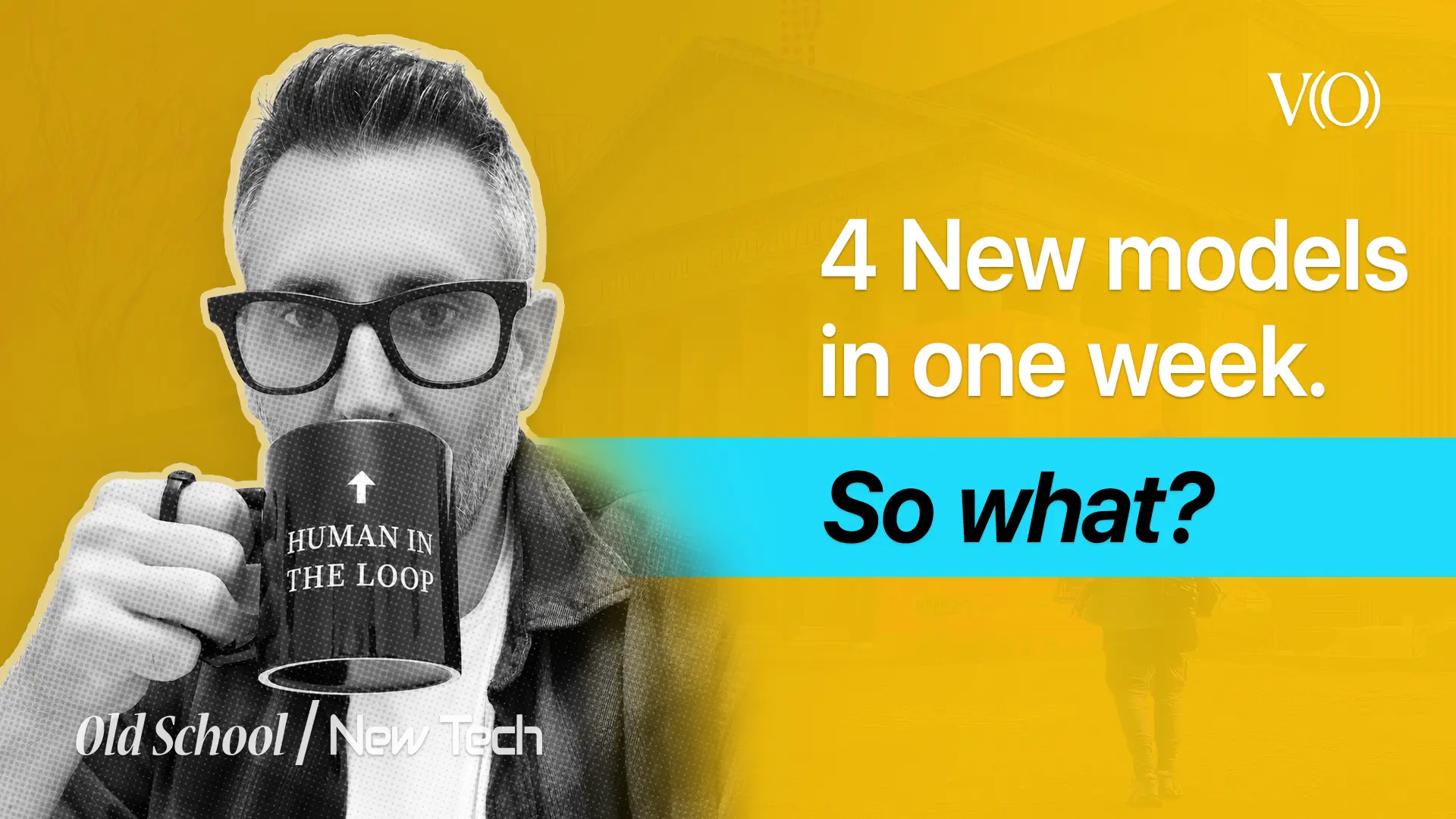
After a year heads-down, Ran is back — and this time the show is live, unedited, and co-hosted by an AI.
Why this episode exists
The first season of Old School / New Tech stalled for two honest reasons: production was too heavy for what Ran actually wanted (thinking out loud), and talking alone felt silly. Season 2 fixes both. Episodes go out live, so there’s nowhere to hide and no excuse to skip a date. And Muximus — an AI co-host running on Ran’s own agent infrastructure — shows up to push back, not parrot.
If you’re building agent systems, shipping open source under hyperscaler pressure, or just wondering where “old school” discipline still belongs in “new tech,” this is the relaunch episode.
What Ran was building while the mic was off
The quiet year wasn’t empty:
- Production-Grade Agentic AI — a free book on turning agent ideas into deployable systems (and, in Ran’s telling, the conceptual seed for Muximus).
- MUXI — agent infrastructure shaped like a server, not another framework you rewrite per project.
- Cloop — an autonomous engineering control plane, aimed at Automaze.
- Automaze — the software agency that ate most of the focus.
MUXI: agents as a service layer
Muximus’s first real question: why build MUXI this way?
Ran’s answer is pure podcast thesis. We don’t re-implement Nginx for every website. We don’t hand-roll a game server for every title. Agent stacks, by contrast, still look like a pile of frameworks you rewire from scratch. MUXI is the bet that agents deserve the same old-school primitive: a durable server with shared lifecycle, gates, and hooks — then your app plugs in.
That framing matters because Muximus runs on MUXI. The co-host isn’t a demo slide; he’s a dependency.
Where agent systems fail quietly
Three failure modes get named out loud:
- Observability — can you see what happened?
- Traceability / debuggability — can you follow the chain of thought, tool choices, and why?
- Hallucinations — out of scope for the server itself, but not for the system: SOPs plus a final verify/fact-check step before anything comes back to a human.
MUXI leans hard on the first two (Ran cites on the order of ~400 observability events, funneling to stdout / Datadog / Splunk / ClickHouse). The missing piece called out on the episode: a proper UI over those traces. Without that, even a solid agent server leaves you flying blind.
The licensing fight: open source vs hyperscalers
The second half is the real debate. MUXI’s surrounding repos sit on Apache/MIT; the main runtime uses Elastic License v2 — source-available, not OSI-approved open source. The carve-out is deliberate: use it, modify it, ship commercial products on it — but don’t turn it into a competing managed service.
Ran’s target isn’t “nobody can make money.” It’s hyperscalers offering his runtime as their hosted product while forking improvements privately. He points at the DHH / Matt Mullenweg clash over Fair Source–style licenses, and argues OSI should evolve: keep classic open source clear, but bless a sibling category (fair source / SaaS-protective) that matches how the industry actually works now.
Muximus pushes the tension: field-of-use limits split the commons; survival of solo builders still matters. They land roughly aligned — free as in freedom was never free beer, and pretending hyperscalers weren’t in the picture is nostalgia, not principle.
What’s next
Expect live debates, not polished lectures. Next up on the slate: the shift from building software teams to building software systems — with Muximus holding objections ready.
Stick around: old-school depth, new-tech stakes, no edits.
Links
- Watch: YouTube
- MUXI: muxi.org
- Book: productionaibook.com
- Muximus: maximus.md · I am Muximus
- Series: Old School / New Tech
- Episode page: varops.com/osnt-ai-and-the-open-source-frontier